


Impact Business Models

Impact Business Models (IBMs) are one of the key aspects of a company's social and environmental performance that are assessed in the Impact B™ Assessment.
NIMs describe ways in which a company, through the way it makes money, is designed to create a specific positive benefit or outcome for one of its stakeholders. They can be based on the structure of the company, the product, a process or a specific activity.
Determining whether your company qualifies for an Impact Business Model is one of the most difficult and nuanced parts of completing the B Impact Assessment. Most companies that complete it have between 0 and 2 NMIs. It is unusual for a company to have 3 or more NIMs.
What is an Impact Business Model?
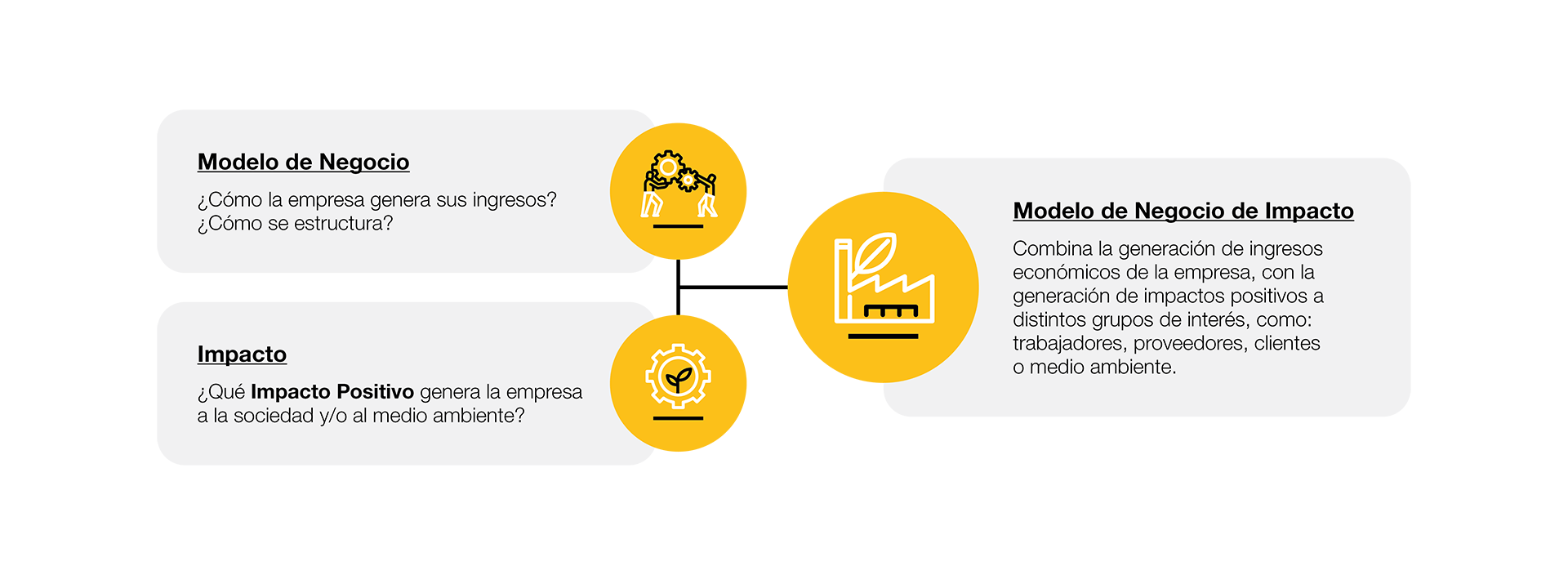
In version 6 of Impact Assessment B, 24 Impact Business Models are recognized.
To analyze whether your company has an NIM, it is useful to consider these underlying principles:
Specific
An NIM seeks to generate a concrete benefit for a specific stakeholder group, rather than a general positive impact without a clear beneficiary or defined benefit.
Example: Tricyclesa company founded in Chile and now headquartered in Brazil, is specifically focused on addressing the problem of waste. Beyond general commitments to preserving the environment and having a positive impact on stakeholders, its business model includes products and services specifically related to waste recycling and advancing a circular economy.
Material
An NIM focuses on delivering real and significant benefits to its specific beneficiary, avoiding minor or irrelevant impacts.
Example: Eco2libriuma company based in Kenya, offers sustainable solutions in energy and forestry. Its high-efficiency stoves, along with other products and services, generate a positive and tangible environmental impactemissions, reducing an average of 64,000 tons of CO2 per year, equivalent to retiring 6,000 cars in the USA.
Verifiable
An NIM is documentable and verifiable, usually through marketing materials, research or internal data.
Example: Culture Ampa climate survey platform in Melbourne, Australia, has an NIM because its service improves the well-being of its clients' employees. The platform tracks data that identifies opportunities for improvement and demonstrates progress.
Durable
An NIM should be integrated into the design of the business. Although over time a company may modify its business to add or remove an NMI, this is not usually a change in the short term. In addition, an NIM does not arise only because of current circumstances, but is part of the essence of the company.
Example: Pumpsa clothing company in New York, has a donation NMI based on its mission to support the homeless. For every garment sold, it donates another. Since its launch, it has donated more than 30 million garments to more than 2,500 organizations, reflecting the strength of its Impact Business Model.
Extraordinary
By definition, an MNI is something that traditional companies do not have, which makes those who possess it extraordinary.
Example: Fairphonean electronics company in Amsterdam, manufactures smartphones with a focus on durable design, fair materials, decent working conditions and recycling. These practices clearly differentiate it from its competitors.